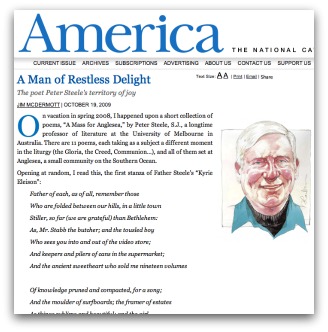
About four years ago I had the great pleasure to spend four days with Peter Steele, SJ while he was at Georgetown. Subsequently I wrote a profile of him that was published in America Magazine, the US Jesuits’ equivalent to Eureka Street.
Hearing that he had died, I went back to those interviews, hours and hours we spent on things like the first time he read Billy Collins ('Goodness, gracious, this man is my friend,' he thought to himself), growing up in Perth, unexpected blessings ('One of the blessings of my life has been the blessing of deep friendship with either agnostics or atheists'), and the never-ending catalogue of characters and words that fascinated and delighted him.
Peter had already been diagnosed with cancer when we met. Though he showed absolutely no sign of it, I felt his poems had begun to dwell more on mortality than earlier collections, and I sought his thoughts on not only his poetry but his sense of life and death.
Most of that material never got published. (As my editors were fond of telling me, I did research as though I were writing a 30,000 word essay when in fact I could only present 2500 words.) And so I offer here a few more clippings of this good man.
MP3 audio files of poetry readings which Peter did during these days in 2009 are available for listening or download here.
Peter on his use of word lists in his poems …
It’s partly a way of saying not so much I know all these words, although it’s a bit of that, but look at all the interesting words that there are. It’s taking the animals on parade. It’s as if after the flood when the ark comes in and the doors open,…and all of these animal words, word animals, creatures have been kept, I would say providentially, over the ocean of time which takes everything away. There’s a famous Latin phrase, tempus redit verum, which mean literally, time the eater of things. Time has got a good side, as we know, but it’s a commonplace that with time everything goes away.
But God, who was the real Noah, the real master of the Ark, saves various things, so I’ll trot these words out, show them alive and well and making more words.
More than that, I’m in love with the plentifulness of things. I think that an excellent prayer, anytime you can’t think of what else to say, is to itemise things, to count your blessings. Everybody’s got blessings that are unique to him or her, so it’s a good religious thing to do to gratefully denominate this. You know, I thank God for the fact that I know how to use pencils, or I thank God for the fact that I like chilli con carne and that I can sometimes get it! (Rarely hot enough in this country, I may tell you, but that’s a separate problem. You can make your own! Which I do sometimes.)
As far as I'm concerned, making lists is as often as not an act of love. It is a love of the items, it’s a love of the words, and I flatter myself to think it’s a part of a love of God.
On the challenge of being a poet …
If you read any collection of poetry that happens to be here, you would find that many of them to a significant degree are dealing with our mixed condition, that is our condition which is partly sweet and partly bitter. On the one hand, the world is so good and beautiful that no words are good enough for it. On the other hand, the world as we have it is so injured that there are no words bad enough for it. It’s a very bittersweet state of affairs.
In a religious context you can see this being modelled if you like in the Psalms which are at one moment singing the praises of all that is, honouring the mountains and the winds and the trees, but on the other hand you have all these cries from the heart – 'Where are you, God? I’m screwed. Come on!' And up and down it goes, up and down, up and down.
And that’s the way it goes in a great deal of poetry. You look to Seamus Heaney, about whom I talk too much, because I love him, and I love his work. On the one hand, Heaney say 'I’m a yes man, that is, I want to say yes as often and as deeply as possible, I’m an applauder.' But he’s a man who says yes only as much as the world will let him. You’ve got to make room for heartbreak in poetry that matters.
But you shouldn’t let heartbreak have the last word, unless you believe that it does have the last word. But of course I don’t believe that.
My brother died of a brain tumour and he’d only been married two years. I married him two years before, best thing that ever happened to him. Best thing that ever happened to the woman I married him to, who was a friend of mine, to whom I had introduced him. There they are in middle age, great thing happens, shortly afterwards he gets this bloody brain tumour, they fight it with surgery and other stuff, and he’s bloated up. Watching him die…awful, awful. So I know the stuff that makes people despair. But I don’t believe that’s the last word. And not only do I not believe it’s the last word in eternity as it were, it’s not the last word every day.
I suppose what I’m saying here is that the challenge to a poet is to try and behave like an adult, the same in a certain sense as the challenge to a priest who is trying to behaving like a Christian, if you see what I mean. If you are an authentic Christian you’re going to be a flawed Christian because that’s the only kind of authentic ones we have. I’m very glad that so many representations of Christ are representations of the risen Christ, but a representation of the risen Christ which has not got the cross inscribed in it somehow, if only in the wounds in the hands, is a piece of fakery.
Yesterday I was in the chapel down the hill with this very striking corpus, and it struck me, in Holy Week the crucifixes are masked, because it’s Holy Week. But at a baptism or at a nuptial mass there’s no convention that you put a white cloth put over the corpus. We leave the dying man there. Even if we fill the church with flowers, with music, perfume, all the good stuff, the dying man is still there, and not only does he have the right to be there, but all other dying men and women and children have the right implicitly to be there, and that’s why he’s there.
On sharing joy ...
You get glimpses of the spacious, of the territory of joy. And if you are the sort of person who genuinely has love for or affection or solidarity with other people to any decent degree, then you would like to help them to join you in the joy. You would like them to join you. Just as I would like everybody to believe in Jesus Christ, not because that would make them like me, but because it would make it better for them. That’s how we work apostolically, not so much come and join the Catholic club, because there isn’t actually a club, though the bishops often talk as if there were, and so do lots of other people. No, it’s not that you want them to join this nonexistent club, but you want their lives to be better and happier.
Now in a more astringent theology of the past you’d say so they won’t be damned, and so they can go to Heaven, but I don’t bloody well believe that, I mean, most people have never heard of Catholicism and presumably never will. God’s looking after them. Why would you think He loves me more than He loves them? That would be ridiculous.
What, if anything, are you still afraid of?
Hilaire Belloc said once that he was afraid – this will scandalise some – he was afraid of dentists and the sea and any reasonably good woman. Well, I’ve been lucky…we don’t have to pursue this now, but I was going to praise dentists. (laughs)
What am I afraid of? I’m afraid of living trivially. Because, that would be living selfishly. And when I am, it is. [What do you mean by trivially?] One instance would be, getting up in the morning and thinking I’ve got today under control and I’m going to make sure that it is. Because to think like that would mean, 'Don’t ask things of me, God, don’t interrupt me or don’t put opinions in front of me that I’m unsympathetic to, don’t be a nuisance to me.' It’s the opposite of being open, and it’s also of course the opposite of being free.
You know, another answer to your question is, I am afraid that I have not been the man that I should be. Now, by this I do not mean that I’ve had the wrong vocation or that I shouldn’t have been writing poems or I should have written more poems. I look at the people whom I know best, whom I most admire, some of them are men, some of them are women, some of them are older than me, some of them younger than me, most are about my own age I suppose, and I look at these people and I think they’ve lived somehow more thoroughly, more deeply, more honestly, more courageously than I have. And I know that in a way it’s sometimes it’s a silly thing to say this, because you can only be you, and you’ve done some things that they haven’t done. And I certainly hope that my last breath would not be a regretful one.
But as long as you’re not seemingly close to your last breath, I think that there is a place for ongoing penitence. Not self-laceration -- as I’ve said sometimes in the past, what you get out of self-laceration is septicemia. I like very much a saying of an Anglican theologian, Austin Fellower, dead some time now: Saints are not people who do not sin, saints are people who are prompt to repent. And I think we behave in a saint-like way, not when we do the things that they have done, because we can’t, but when we follow their style. So you can have a Franciscan heart and be a millionaire. It may not be all that frequent but it can be done. You can have a Franciscan heart and be a war chaplain. In fact the more Franciscan your heart is, the better war chaplain you’re gonna be, because those poor buggers need you.
I’m not, I hope, so stupid as to say to God you should have made me him, you should have made me her. This would be both impertinent and very stupid. But one can be challenged. In the Ignatian tradition we’re asked to be as generous as we can, not as it were out of common decency and gratitude, although that’s a very important thing, but because grateful people become receptors and vectors of God’s love in the world in a way that ungrateful people can’t. Being grateful makes good apostolic sense, and hardly anything else does. So, that’s a wish, and a hope.
What do you think happens when you die?
Oh, I’m a great believer in Heaven. And I’m happy, as in the case of Mexican Night, to write merry poems which are by definition not entirely serious, but somehow subtend the heavenly condition.
I believe almost obsessively in the resurrection of the dead. And I fervently hope and it is certainly orthodox to believe that everybody will be saved, including the monsters. I mean, for a million years you mightn’t want to go and visit them wherever their mansion was in Heaven, to put it frivolously, but that’s a kosher thing to believe for a Catholic, and I very much hope that’s it’s so. I don’t know whether it’s going to be so or I not, but I hope that I will get there and I hope that a vast majority of people get there.
Of course trying to talk about Heaven -- even trying to name the condition, calling somewhere Heaven or calling something Heaven -- is as we say metaphorical behaviour. As talk about Hell would be. But I reckon there should be more people talking about Heaven, there should be more priests preaching about Heaven, A), because I believe it’s true, but B), because it is a way not of talking about us having good luck. We’re not being driven by fate, we’re being drawn by love.
I think and I hope with all my heart that in the course of our lives, even if it is only at the last instant, we all give our hearts to God, the source of all love, enough to make us in some sense or other eligible to have that love flood us not only more than it ever has before but more than anybody could conceive that it might. I hope that that’s what happens and that it happens to us all.
Peter Steele, may you rest in peace.
 Jim McDermott SJ is a former associate editor at America Magazine. He is currently studying screenwriting at the University of California in Los Angeles.