: A publication of Jesuit Communications Australia
Podcasts (all articles)  |  Join us on Facebook   |  Follow us on Twitter
EUREKA STREET  
Search our site
You can search by topic, author, article title and keywords.


Advertisement


Advertisement

Advertisement

1pix
smaller font larger font print article Email this Article to a Friend Bookmark and Share
Home » Vol 22 No 17 > Exempting churches from anti-discrimination laws
THE MEDDLING PRIEST

Exempting churches from anti-discrimination laws

Frank Brennan September 06, 2012

Legal Protections for Religious Freedom

Church groups in Australia have been engaged in a gruelling campaign to maintain what they regard as justifiable exemptions from the provisions of equal opportunity employment laws. They want to maintain the ethos of their educational institutions and remain true to their teachings on questions such as family relationships. Cardinal Pell makes the point nicely:

Should the Greens have the right to prefer to employ people who believe in climate change, or should they be forced to employ sceptics? Should Amnesty International have the right to prefer members who are committed to human rights, or should they be forced to accept those who admire dictatorships? Both cases involve discrimination and limiting the freedoms of others, and without it neither organisation would be able to maintain their identity or do their job effectively. Church agencies and schools are not exempt from anti-discrimination law in New South Wales, and the language of ‘exemptions’ is misleading.

While there may be strong agreement about the need to maintain a faith community’s right to employ in certain positions only persons who live in conformity with religious teaching, there is plenty of room for disagreement as to how most prudently and charitably to exercise that right.

It is not only secularist, anti-Church people who think that Church organisations and leaders would be displaying homophobia by singling out only gays and lesbians for exclusion from employment in some key positions when heterosexual persons are also living in what the Church might formally regard as irregular situations.

I applaud the Prime Minister’s statement yesterday in response to the claims by the Australian Christian Lobby about the harmful effects of homosexual relationships.  I agree with Ms Gillard’s claim that ‘to compare the health effects of smoking cigarettes with the many struggles gay and lesbian Australians endure in contemporary society is heartless and wrong’.

During the 2009 National Human Rights Consultation, former NSW Premier Bob Carr told a conference convened by the Australian Christian Lobby and the Catholic Archdiocese of Melbourne that one of the chief advantages of not having a Charter of Rights was that church leaders could deal directly with government.

He told the story of the two Archbishops of Sydney coming to see him as premier when there was discussion about a proposed Bill to restrict the freedom of Churches to employ only those persons living consistently with Church teachings. He was able to give them an immediate assurance that their interests would be protected.

It is a matter for prudential political assessment. I think those days have gone. It is a good thing for society that elected political leaders and church leaders are able to meet and talk confidentially. Whatever the situation in the past, it is now not only necessary but also desirable for religious leaders to give a public account of themselves when seeking protection of freedom of religion within appropriate limits, especially when they are in receipt of large government funds for the provision of services to the general community, and not just to members of their faith communities. 

Religious special exemptions regarding employment are all the more defensible when religious personnel including religious leaders and those with the hands-on directing of religious agencies are prepared to appear before a parliamentary committee and provide a coherent rationale for those exemptions, rather than simply cutting a deal behind closed doors with the premier or prime minister of the day. The Australian Catholic Bishops Conference has made a submission to the Commonwealth’s present inquiry into the harmonisation of discrimination legislation.

In another submission to the inquiry, Professors Patrick Parkinson and Nicholas Aroney observe:

Great care needs to be taken to ensure that a focus on the first-mentioned right (freedom from discrimination) does not diminish the others (e.g. freedom of religion, association and cultural expression and practice). This can readily happen, for example, if freedom of religion is respected only grudgingly and at the margins of anti-discrimination law as a concessionary ‘exception’ to general prohibitions on discrimination. It can also happen if inadequate attention is paid to freedom of association and the rights of groups to celebrate and practise their faith and culture together.

Last year, the new Baillieu government amended the Victorian Equal Opportunity Act. Those amendments replaced the more restrictive “inherent requirement” test for employment which had been introduced by the Brumby Government.

The Victorian law once again permits religious bodies to be discriminating in their employment practices in relation to “religious belief or activity, sex, sexual orientation, lawful sexual activity, marital status, parental status or gender identity” provided only that the discriminatory practice “conforms with the doctrines, beliefs or principles of the religion” or “is reasonably necessary to avoid injury to the religious sensitivities of adherents of the religion”.

The religious school can be discriminating in their employment of the gardener or maths teacher, just as they can be in their choice of the religion teacher or principal. Attorney General Robert Clark when introducing the amendments said that the “so-called inherent requirement test would have the consequence that faith-based schools and other organisations could be forced to hire staff who are fundamentally opposed to what the organisation stands for”.

It would be regrettable if religious bodies were to exercise this liberty in a manner inconsistent with their own religious commitments to respecting the human dignity of all persons, including those who are gay or lesbian or not living in church authorised marriage relationships. The scrutiny of unauthorised sexual practices needs to be equally applied. In the parliamentary debate at least one Coalition member, Mr Newton Brown, warned:

I would like to put on record tonight that faith-based schools should be on notice. Yes, the election commitment to remove the inherent requirements test will be realised by this bill, as was promised by the Coalition, but make no mistake: this does not open the door for schools to engage in unfettered discrimination against people that is not justified in light of an organisation's beliefs.’

When seeking to balance conflicting rights, there may be a case for permitting a fuller expression of religious liberty and preferences when alternatives exist elsewhere in society for persons seeking non-discriminatory opportunities or services. 

For example, the UK now insists that all registered adoption agencies, including Catholic ones, provide a non-discriminatory service such that adoption would be as readily available to a same sex couple as to a man and woman wanting to adopt a child into their family. 

In my opinion, it would be no interference with the rights or dignity of gay and lesbian couples if some religious adoption agencies acting on their religious beliefs gave preference to married heterosexual couples when determining adoptive parents for a child, provided always that the agency was acting in the best interests of the child. There would still be a range of non-Church adoption agencies providing services to all couples, including gay and lesbian couples.

It is legislative overreach for the state to insist on uniform non-discrimination for all adoption agencies. If all schools or even the majority of schools were faith-based, there would be a stronger case for anti-discrimination provisions applying more broadly in employment situations for teachers. With the present mix, the Victorian Parliament has got the law right.  

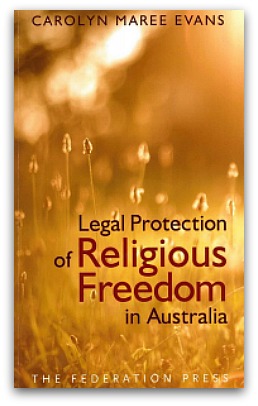
This is an extract from Frank Brennan’s speech last night at the Melbourne Law School launching of Carolyn Evans’ book Legal Protection of Religious Freedom in Australia (Federation Press). The full text is here. 


Frank BrennanFr Frank Brennan SJ is professor of law at the Public Policy Institute, Australian Catholic University and adjunct professor at the College of Law and the National Centre for Indigenous Studies, Australian National University.


Bookmark and Share

Enjoyed this article? To ensure that Eureka Street can continue its 20 year publishing tradition, click here to make a donation to Eureka Street.

To email to a friend, click here.


COMMENT ON THIS ARTICLE


Submitted feedback is moderated. Email is requested for identification purposes only.

Name:
Email:
Comments:
Word Count: 0
(please limit to 200)


SUBMITTED COMMENTS


Fr Mick Mac Andrew07 Sep 2012

While Fr Frank always makes sense and, in the case of his priesthood, always is 'evangelising', that is, seeking life in all its fulness for everyone, after all, we are all "sinners and fall short" as St Paul says, there is one big flaw in this opinion piece, like there still is with his opinion before the last federal election that a Catholic would be able to safely vote for the Greens. Not all involved in opinion giving and legal construct in our nation would be operating out of the integrity of life and thinking and wisdom as Fr Frank. Some would even be acting against anything he proposes, such as the Greens. Jesus warned us about the wolves in sheep's clothing, so how is that warning to be reconciled with "doing business with the devil" in the many situations faced by the Church today. And I, as a Parish Priest in a rural community face such a very issue and the choices are stark, how to evangelise, even Catholics, caught up in a duality of life situation, desiring to be faithful, but enmeshed in personal circumstances. Tolerance yes, God's grace yes, but how to say "go, sin no more?"


Garry07 Sep 2012

Frank, I am intrigued by your last paragraph. Does this mean, that because we have e.g State Schools, gays and lesbians can seek employment there, because those schools can't discriminate? Also, are you saying, that if there were no State schools, only Faith-based schools, then these latter schools would then need to consider more carefully their policies of discriminating against the employment of gay people? It seems to me that this is tantamount to saying :only if others (State schools, because they don';t exist in the hypothesis) can't employ gay people, then the Catholic school should probably not be exempt either. I thought we should not discriminate in any way against gay people according to Church teaching. Often, such discrimination is based on judgements about the potential morals involved, and as you rightly point out Catholic employers can conveniently turn many a blind eye on those Catholics in irregular relationships, as you call them. Something does not seem right here.


Brian Goodall07 Sep 2012

A balanced article. The Greens in particular and some other politicians wish to force us into a position which is against our beliefs - they would not tolerate any form of criticism towards their ideologies. We need to respect and perhaps accept other views but not be forced into a compromising situation.


Michelle Goldsmith07 Sep 2012

How many members of the Catholic priesthood are gay? Some very credible US studies ( as cited by Fr Donald Cozzens) put the number as high as 70%. In addition, many of these studies note that, in many situations, the pastoral effectiveness and ability to engage and empathise with diverse members of the communities they serve is higher amongst gay clergy. Do seminaries have "don't ask, don't tell" type policies?


Toluana07 Sep 2012

I am Catholic and a Greens voter - the Greens are a voice for the disadvantaged and those seeking help, they are a voice for the environment and earth's future for all its inhabitants, and they support a transparent and multi-cultural society with all beliefs and cultures expected to value the inherent worth of all people. Sound familiar? Thankfully I know that Catholic schools in my diocese employ non-Catholics, welcome families of other or no faiths, and value their brilliant, kind and talented teachers who happen to be gay. This is what I understand Catholicism should be about.


L Newington07 Sep 2012

I don't know any Green politicians or their policies, but I have to say since David Shoebridge has taken up the gauntlet and running with it for those needing a hand up, he will be gaining support from an unprecedented band of grateful constituents in the making.

Justice is what our faith is all about, with out it there is no peace, and from where I stand he seems to be a better example of what being a Catholic entails than many given the gift through their birthright.


Frank S07 Sep 2012

Toluana, in the interests of balance, how do you respond to the comments at the following link claiming an inherently anti-church school bias in the Greens' school policy?

http://www.theaustralian.com.au/national-affairs/opinion/a-clear-danger-to-catholic-school-autonomy/story-e6frgd0x-1226430370548


Pam08 Sep 2012

I've only just got around to reading this article in depth. I think church groups should have the right to employ only people who are believers in that particular faith system. In particular relation to schools, a Catholic school should give preference to those 'in the faith'. As someone who has worked in the public school system I've worked with many teachers who live their lives with as much integrity as any believer and are fine teachers but who have no religious affiliation. Their lack of religious belief does not impair their ability to impart sound values to their students. I also believe the public system offers the best (for all of society) possible education, if it is given the funding it deserves. I say this as an imperfect Christian. It's in our weakness that we draw close to Christ.


Bev Smith09 Sep 2012

In my experience the non-catholic staff in our schools have often lived the christian example admirably. They are always careful not to do or teach anything against the status quo.


AURELIUS09 Sep 2012

I'm a bit baffled as to how Fr Brennan came up with the gay/lesbian parent adoption issue as a possible area where a church could legitimately discriminate. What "religious belief" would the church adoption agency be acting on to favour a heterosexual couple? It can't be sexual morality because obvioulsy with adoption the child has already been conceived. And if it's a marriage/de facto issue, that is merely a legal technicality and will probably be resolved soon as gay marriage laws take form. So the only possible "religious issue" the church could possible hold up as "legitimate discrimination" is that one couple is homosexual. It suggests that prospective parents will be evaluated not on their dedication, love and commitment as parents, but simple on the fact that they are male/female heterosexual. I'm not up on the latest sociological research about the long term social consequences of family structure ie, single, gay, hetero, couples, de factos, but I have read enough to know that it's the love and caring that's provided that makes all the difference, not the heterosexuality. And in previous articles in ES, I recall Fr Brennan using the most unprincipled argument point against homosexual couples having families - because of the cringe factor and the image and confusion it might cause in the playground from other students teasing and ridiculing the childs family structure. I say live and let live according to Christ's example and words and teachings - let's not dress up our bigotry with illogical religious arguments.


Joan Seymour10 Sep 2012

Aurelius, I don't like exemptions from anti-discrimination laws in general. I'd like Catholic schools to be able to employ teachers on the basis of their abiity and their willingness to respect the ethos of the Catholic church, whatever their sexual direction, race, creed etc. However, Frank's example of desirable discrimination strikes me as being accurate. If I were a relinquishing mother, I'd like to be able to stipulate that my child be brought up by a suitable heterosexual couple. I have homosexual friends who are good parents, but my ideal parent couple are good heterosexual parents. I do think ideally a child has one good parent of each sex, but the anti-discrimination laws wouldn't allow me to chooe this for my child.


Hh10 Sep 2012

I strongly support the comments or Fr Mick and Garry, above. I have the same questions, and, typically, they are sedulously avoided.


L Newington14 Sep 2012

Aurelius, maybe the adoption issue is because the church defines the right of the child to a father and mother according to the UN Convention.
That depriving the child of that right is a violation of the right of the child.
No doubt that will the next hurdle to avoid discrimination, then maybe not.
The Religious Discrimination guidelines state: A religious body is also permitted to do "other things" that conform with it's doctrine, or are necessary to avoid injuring the religious feelings of members of it's faith.
Not withstanding the reality of contradictions when the father is a clergyman.


AURELIUS17 Sep 2012

L. NEWINGTON , I agree with you and support all rights for children etc, but for the sake of logical and consistent argument in this case, if the church discriminates against homosexual couples in the area of parenting, then it must also discriminate against unwed heterosexual couples and divorcees. I don't know how a church could prevent unwed or non-church-married couples having children the natural way - but in the area of adoption it would need to apply the same discrimination policy if it's to follow it's own moral teachings.


Michael Furtado22 Jan 2013

I realise I'm a little late in offering an opinion here but the imperative to do so arises out of the extraordinary response to Patrick Stokes's current brilliant article, 'Love thy neighbour: religious groups should not be exempt from discrimination laws' in The Conversation. Unlike Frank, Stokes has faced the full strength of legal and public opinion, some of it more sophisticated and polished than others, with considerable politeness and equanimity, in a way that Andrew Hamilton also displays in these columns. It matters enormously that both opinion writers regularly respond to the challenges that are put to him. It is not enough, by comparison, for Frank to overlook Garry's considerable point here, exposing the exaggerated argument Frank resorts to in justifying discrimination against gay employees by the Catholic Church. Nor indeed does anyone address the standard justification, offered by Cardinal Pell, and recorded in the signed interview script for my PhD thesis (University of Queensland, 2001) in which he states that the Church rejects all arguments for Catholic school funding equivalent to that of state schools in order to secure its exemptive status. It shouldn't surprise that any government favouring fiscal austerity over matters of principle should quickly agree.


Michael Furtado22 Jan 2013

I wished to add to my earlier post the following observations in respect of Garry's insightful challenge. It requires a lot of optimism to think that Frank's pragmatic solution for gay employees to avail of work in the non-religious sector is likely to obtain usually in practice. Lots of government service providers are religious and rurality confers much less of an employment choice than living in cities. Moreover, even if it did obtain, one might worry about whether it reflects ‘adaptive preferences’. There are notionally active and practising gay Catholics, such as myself, whose religiosity inclines them to work in the Catholic sector. Even more unsettling, some employees of Catholic institutions might simply work in them in order to access employment without regard to its faith values, yet their evident disinterest advantages them over others with a more engaged view. While it would be wildly optimistic to dismiss the possible conflict between wide latitude to discriminate and equality of opportunity as negligible, it is surely virtuous that identity disclosure, at least to a Catholic employer, should be commended as an act of honesty and the applicant appointed, as indeed all employees ought to be, with sufficient prudential advice against proselytising.


Previous Articles by this Author

THE MEDDLING PRIEST

Time to draw the line between Australia and Timor Leste  

East Timor flagAustralian governments of both political persuasions have reassured the Australian public that they are decent and special when it comes to dealing with the Timorese over disagreements in the Timor Sea. Time for such special pleading is over. For the good of ongoing relations between these two unequal neighbours, it is time for Australia to commit to negotiating final maritime boundaries.


THE MEDDLING PRIEST

Malaysia Solution is dead in the water  

Little girl in pink T-shirt crouches near blue UNHCR backbacks

It is time for each side of politics to stop blaming the other for the increasing wave of boats and for Gillard to cease invoking the unreal prospect of a revised Malaysia Solution. A revised arrangement consistent with the recommendations of the Expert Panel is an impossibility before the election.


THE MEDDLING PRIEST

Abbott's quest for constitutional inclusion  

Map of Australia made up of faces from different culturesGiven the opinion polls and divisions in Labor, it's no surprise Abbott is confidently preparing his team for government. Anything he says about constitutional change therefore carries weight. Advocates for constitutional recognition of Indigenous Australians would be heartened then by two of his recent speeches. 


THE MEDDLING PRIEST

University as an agent of transformation  

'Transformation and empowerment will come through the exercise of kindness and tenderness, accompanied by the practical abilities inculcated by a rounded Catholic education.' Frank Brennan's address at the Transformation and Empowerment Symposium marking 50 years of the Signadou campus of ACU, 22 March 2013.


THE MEDDLING PRIEST

Rudd right not to run  

Some lamented that Rudd had abandoned his own supporters to their fate. But what political morality would dictate that he break his word simply because Crean had decided an immediate challenge was the only available circuit breaker for the woes of a dysfunctional divided Labor Party?


THE MEDDLING PRIEST

Recognising Aboriginal and Torres Strait Islander People in the Constitution  

Frank Brennan's address 'Recognising Aboriginal and Torres Strait Islander People in the Constitution' presented at the 18th National Schools Constitutional Convention, The Museum of Australian Democracy at Old Parliament House, 21 March 2013.


THE MEDDLING PRIEST

How can the Catholic Church contribute to a better culture for life?  

Change is upon the Church. Just recall the scene when the new pope emerged on the Vatican balcony. He appeared with none of the papal trimmings of office, and did not once did he refer to the papacy. Could something of this new papal style help Catholics engage more creatively with their fellow citizens? Text from Frank Brennan's lecture 'How Can the Catholic Church Contribute to a Better Culture for Life?'


THE MEDDLING PRIEST

Church blame in the frame  

Religious icon weeping bloodThere is a temptation to see justice, compassion and transparency as the obsessive concern of western liberals. They are much more universal than that; they are the contemporary, institutional rendition of gospel values. The unaccountable hiddenness of Vatican clericalism has reached its use-by date.


THE MEDDLING PRIEST

Inspirational Abbott's Indigenous aspiration  

Eddie MaboLet's not underestimate the significance of John Howard's successor giving credit to Paul Keating for his Redfern speech, before invoking New Zealand's Treaty of Waitangi and calling for atonement. Still there is plenty of work to be done to attain proper constitutional recognition of Indigenous Australians.


POLITICS

Clarifying the anti-discrimination muddle  

Muddle, letters mixed upThere has been some very confused debate about the Government's proposed consolidation of anti-discrimination laws. David Marr claimed leaders of 'conservative faiths' were free to 'kick poofters, lesbians, single mothers, people in de facto relationships'. He needs to take a cold shower while we clarify these issues. 


More from this section


Australia takes the low road on asylum seekers
Frank Brennan 16-Aug-2012

All major political parties now hope they can confine people in Nauru for years on end without any prospect of court supervision and without any need for Parliament to revisit the matter. We have reached a fork in the road between decency and deterrence. As a nation we have taken the low road, inviting the newest signatory to the Refugees Convention to emulate our indecent behaviour.


Read more
26 comment(s) about this article.


Houston report's high cost of deterrence
Frank Brennan 13-Aug-2012

Amending the Migration Act to make the old style Pacific solution less susceptible to judicial review errs on the wrong side of decency. The Coalition and the Greens should unite in the Senate to oppose it. In the protection of the human rights of asylum seekers, deterrence must come second to decency and accountability, even when we are trying to beat people smugglers.


Read more
27 comment(s) about this article.


Malaysia solution is not there yet
Frank Brennan 09-Aug-2012

Green tick Next week Parliament reconvenes; meanwhile the boats keep coming. Chris Bowen will be armed with a report from an expert panel that has been hearing from the community. We're still awaiting an answer on unaccompanied minors under the Malaysia solution. Until one is provided no one in good conscience can give it the tick.


Read more
9 comment(s) about this article.