: A publication of Jesuit Communications Australia
Podcasts (all articles) | Join us on Facebook   |  Follow us on Twitter
EUREKA STREET  
Search our site
You can search by topic, author, article title and keywords.
 
SUBSCRIBE TO DAILY ALERTS NEWSLETTER
EMAIL 


Advertisement


1pix
smaller font larger font print article Email this Article to a Friend Bookmark and Share
Home ยป Eureka Street Extra > Pope confronts economic injustice
APPLICATION

Pope confronts economic injustice

Bruce Duncan July 10, 2009

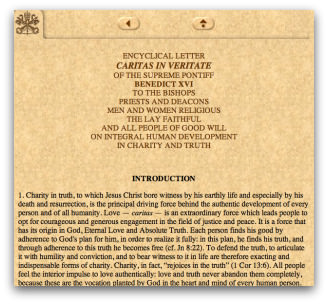
Caritas in VeritatePope Benedict's new encyclical is not the strident critique of capitalism some were expecting, but it is nonetheless a robust critique of abuses in the global economy, particularly in financial markets. The Pope also highlights the scandalous contrast between the ostentatious wealth and profligacy by richer people and countries, and the acute deprivation of many millions of others.

Benedict has written this 30,000-word encyclical, Caritas in Veritate (Charity in Truth), commemorating Pope Paul VI's 1967 encyclical, Development of Peoples, to inject into current debates the Church's alarm at the injustice inflicted on hundreds of millions of people, and its concern the plight of impoverished peoples will be ignored.

Development of Peoples was aptly named, and caused a sensation throughout many developing countries, invigorating Church and community groups everywhere to prioritise the urgent demands of world development. In Pope Benedict's view, Development of Peoples set a fresh course for human endeavour.

Though he does not use the term 'neoliberalism', Benedict is critical of the free market ideology which extolled wealth creation but ignored the need for equity and social justice. Astonishing wealth was accumulated in the hands of a few, and the great opportunity to redistribute wealth more widely to wind back hunger and poverty rapidly has been jeopardised at the cost of millions of unnecessary deaths.

Benedict sees commitment to improving human wellbeing as essential to Christian religious belief. Indeed, Paul VI recognised in the notion of development 'the heart of the Christian message'

Benedict is careful to distance this effort from political messianism or utopian ideologies, since he knows we can never achieve a perfect world on earth. Nevertheless he writes that it is the task of Christians to build up the 'earthly city' to embody human values more fully, prefiguring the final Reign of God which only God can bring.

The Pope insists that the Church must help promote 'integral human development', adopting a public role in addition to her activity in charitable and education work. Indeed he sees the task of human development as a vocation, a call from God, for each of us, which 'involves a free assumption of responsibility in solidarity on the part of everyone'. The Pope places this vocation in the framework of transcendence before God, recognising other people are made in the image of God, with immense dignity and the rights that spring from that.

He also insists on the need for distributive justice and social justice in the market economy, since without these forms of internal solidarity and trust the market will fail. Hence the market must be directed by the State and civil society to ensure that wealth is ethically distributed. He writes that recent developments in market economies are threatening the redistributive functions of states.

'The processes of globalisation ... open up the unprecedented possibility of large-scale redistribution of wealth on a world-wide scale; if badly directed, however, they can lead to an increase in poverty and inequality, and could trigger a global crisis. Indeed, he warns that the benefits of globalisation 'have ended up largely in the hands of people from developed countries', and he warns against the power of 'private interests'.

None of this will surprise people familiar with Catholic social teaching. You will also find in the encyclical his strong support for trade unions and their rights to represent their members. The Pope urges unions to take a greater role in advocacy also for non-members and other disadvantaged groups.

All is not gloom and doom for Benedict. He recognises that the human race has tremendous resources, including skills and technology, to bring to the fight against hunger and poverty. But to succeed we will need to be smart in how we remodel our societies, taking special care for the environment and the prospects for future generations. We will need to live more modestly, adopting new lifestyles so that everyone can have enough for a decent life.

As Benedict concludes: 'The current crisis obliges us to re-plan our journey, to set ourselves new rules and to discover new forms of commitment, to build on positive experiences and to reject negative ones. The crisis thus becomes an opportunity ... to shape a new vision for the future.'


Bruce DuncanFr Bruce Duncan is one of the founders of the advocacy organisation Social Policy Connections and director of the Yarra Institute for Religion and Social Policy.


Bookmark and Share

Enjoy this article? To email to a friend, click here.


COMMENT ON THIS ARTICLE


Submitted feedback is moderated. Email is requested for identification purposes only.

Name:
Email:
Comments:
Word Count: 0
(please limit to 200)


SUBMITTED COMMENTS


Brian Haill09-Jul-2009

When Pope Benedict gets around to ... admitting, meaningfully addressing and correcting ... the global abuses of the church, his encyclicals might attract some interest.

The problems of capitalism, as well as those of the papacy, have been with us for centuries.

The church needs to bridge the ginormous gap between what it preaches and what it doesn't yet practice ... reality in truth


M.Confoy10-Jul-2009

Great contribution to our appreciation of this important document at this time Bruce. thanks a million (would that this were in dollars!)


David Arthur13-Jul-2009

Good on Benedict for stating the bleeding obvious ... that communities are the contexts within and between which our economy exists, and on which our economy depends.

While separation of Church and State is desirable, but these neo-liberal "Masters of the Universe" would do well to heed Benedict's words. They have been so wrong for so long, they clearly deserve pay-cuts ... for the term of their natural lives.

Keynes had it right, economy really does exist to serve humanity, not the other way round.


Theo24-Jul-2009

Perhaps the Catholic Church could set the example re wealth redistribution, and help to feed the starving and those suffering shocking deprivation ....... beginning with the pious and obedient Catholic / Christianised peoples of the impoverished South American and African continents ....!!!!!


Previous Articles by this Author

POLITICS

Don't despair of election 'race to the bottom'  

The election has been plagued by trivial spats and personality conflicts, to the neglect of policies based on the values of equity and social justice for everyone. This reinforces the importance of church and community groups being more active in their social advocacy.


FEATURE LETTERS

Disagreeing with Gerard Henderson  

Dr Henderson does Maritain a grave injustice in so cavalierly dismissing him as favouring the 'you-beaut idea to advocate Catholic/communist dialogue'. Maritain was strongly opposed to communist ideology, but he also recognised it contained positive elements, some of which he said were drawn with the Gospels.


POLITICS

Rosemary Goldie and the Santamaria Split  

Crusade or Conspiracy: Catholics and the Anti-Communist Struggle in Australia In July 1953, the Vatican's agent Rosemary Goldie — who died on 27 February — met Santamaria but was unable to convince him of the need to keep Catholic Action out of direct political involvements. She was dismayed by the Movement's defiance of clear directives from the Holy See.


RELIGION

Pope's fighting words for a world in crisis  

Blueprint for a safer planet, by Nicholas SternIn his World Day of Peace statement for 2010, the Pope again highlights the urgency of responding to climate change. Pope Benedict has had major problems in communicating this message, notably a lack of journalistic expertise to make his documents more readable.


RELIGION

The popes versus the free market  

Pope BenedictIn his forthcoming response to the global financial crisis, Pope Benedict does not have to reinvent the wheel. Catholic social writings have long insisted that economics must be directed to serve the good of everyone, not just the rich.


BOOKS

Obama vs the 'ethic of greed'  

Audacity of Hope, Barack Obama ISBN: 9781921351365Obama embraced Christianity because of his involvement with church groups, sustaining the moral vision of oppressed blacks. He has sketched a vision of social renewal that overlaps closely with Catholic and Christian social thought.


RELIGION

Reality check for antisocial Church  

Make Poverty HistoryThere is tension in the churches between those focused on piety and those engaged with social justice. Benedict's document on globalisation will presumably stress that concern for social justice is essential to the Church's mission.


RELIGION

Just war I  

The history, the current circumstances


APPLICATION

The war of the willing  

Western intelligence agencies fell down  badly over Iraq. So did our consciences, argues Bruce Duncan.


RELIGION

Rome and the bush  

Bruce Duncan looks at the role of the church following the war in Iraq


More from this section


Pope's 'seamless garment' bares green credentials
Neil Ordmerod 10-Jul-2009
This week's release of the new social encyclical Caritas in Veritate expands moral teaching to promote a concept of 'human ecology' that covers both human life and the environment. It would seem that Benedict is not a climate change sceptic.
Read more
2 comment(s) about this article.


Pope Benedict's greed-free capitalism
Paul Oslington 15-Jul-2010
Some commentators have latched on to Benedict's encyclical Caritas in Veritate as a new 'third way' between socialism and capitalism. This is a remarkably bad idea.
Read more