: A publication of Jesuit Communications Australia
Podcasts (all articles)  |  Join us on Facebook   |  Follow us on Twitter
EUREKA STREET  
Search our site
You can search by topic, author, article title and keywords.


Advertisement


Advertisement

Advertisement

1pix
smaller font larger font print article Email this Article to a Friend Bookmark and Share
Home » Vol 22 No 17 > Holistic cures for school snobbery
EDUCATION

Holistic cures for school snobbery

Ellena Savage August 30, 2012

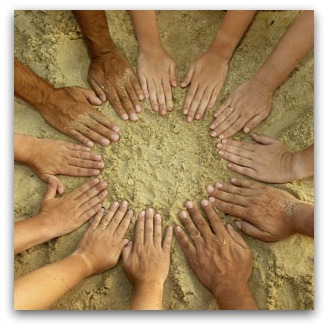
Multicultural handsOnce, my mother reprimanded a young student she taught music to at an expensive private school. He told her that his dad could 'buy and sell' her. His father was apparently wealthy.

Once, while accompanying a friend to his year 12 formal at one of Melbourne's most selective and expensive boys schools, a student asked what school I went to. When I mentioned the name of my small state school in Melbourne's northern suburbs he responded, 'Well, you're moving up in the world.'

As easy as it would be to draw from these anecdotes that private schools breed poor behaviour, rude children are just that — class has little to do with it.

People who have had a taste the different classes within Australia (and they do exist) will understand that where humility is concerned, notions of privilege or disadvantage rarely come into it. Children learn behaviours from their surroundings, and as they are exposed to a greater diversity of experiences, their behaviours develop into those which are socially acceptable, and socially advantageous.

The little boy interested in buying and selling his teachers quickly learned — from the principal and his family, who were horrified — that he had watched too many movies. The young man wearing his entitlement on his blazer sleeve will probably have learned by now that there's no social advantage in making oneself unlikable.

Of my 13 years of primary and secondary school, four were in Catholic schools, the other nine in government schools. The Catholic schools were not 'elite'; their fees were low, and students came from all backgrounds. The government school was similar, but had an ESL school affiliated, so my classmates came from all over the world.

It was a good school by any measure except academic, where I learned about Coleridge and Beckett, the languages spoken in Eritrea, how to write a letter to the prime minister, and the meaning of Ramadan.

Students from that school are now themselves teachers, academics, artists, mechanics, students, business owners, real estate agents, nurses, dole bludgers, doctors, shopkeepers, musicians, and public servants. Some are in jail and some are dead.

Many of them are doing what would have done regardless of what school they had been zoned to, because they had great teachers, and families who were able to support their development, with or without money. Some of them didn't have a privileged family life, and needed greater care than teachers could be expected to provide. It is they who don't have the lives they deserve, or don't have lives at all.

Although the uni I went to was just ten minutes on the tram from my high school, some former classmates thought it was posh, or part of an inaccessible world. In reality, the students at uni were just as varied in their personal discipline, academic skills, and interests, as the students in my high school had been.

Some of them had simply come from a school system that emphasised the importance of university admission. This is an impoverished approach to education, and is not limited to private schools.

Students ought to be given the opportunity to encounter reality before they enter it. Reality being that people are poor; that some have survived torture and trauma that can make them dysfunctional; that there are barriers to success outside the power of one's 'personal responsibility'. Without such opportunities, education is about little more than tertiary admission, or the promise of a life without ever confronting these realities.

Children learn behaviours from their surroundings, so it follows that for a thorough education, their surroundings should be as diverse as possible. Limiting interactions between classes, and consequently between ethnic identities and ability levels may facilitate an easy entry into university.

But education should be about much more than grooming children to be workers and consumers. Learning from students with diverse backgrounds and abilities supports a holistic education.

There is serious disadvantage in Australia. You won't see it in the wealthy private schools, or even in the state schools in affluent neighbourhoods. Pouring more resources into the disadvantaged within the education system won't totally extinguish the inequities we face at birth. But ignoring the emancipatory power of education is a sure way of perpetuating disadvantage. Rather, of condoning it. 


Ellena SavageEllena Savage is a Melbourne writer who edits Middlebrow, the arts liftout in The Lifted Brow


Bookmark and Share

Enjoyed this article? To ensure that Eureka Street can continue its 20 year publishing tradition, click here to make a donation to Eureka Street.

To email to a friend, click here.


COMMENT ON THIS ARTICLE


Submitted feedback is moderated. Email is requested for identification purposes only.

Name:
Email:
Comments:
Word Count: 0
(please limit to 200)


SUBMITTED COMMENTS


Uncle Pat31 Aug 2012

Just how useful is the concept of class in a society such as Australia? I don't deny social distinctions and social differentiations exist. If a catholic Uni student mentions that he went to Riverview in Sydney he is immediately stereotyped and treated accordingly - embraced by some, ostracised by others. If he adds that he was there on a sports scholarship - he is placed in another catergory - embraced by some, ostracised by others. If he adds he is a tee-totaller, the number of fellow students interested in him becomes smaller and smaller. I am indebted to Max Weber for the above. He postulated that classes are not social groups but aggregates of people possessing the same life-chances. But interestingly within those aggregates horizontally and between those aggregates vertically there are rude/impolite/bad-mannered/disrespectful/insulting/supercilious/ contemptuous people. How they got that way I don't know. Nature or nurture? Genes or the environment? Queen Victoria wrote: "You will find as the children grow up that as a rule they are a bitter disappointment - their greatest object being to do precisely what their parents do not wish and have anxiously tried to prevent." The more things change, the more they stay the same.


AURELIUS31 Aug 2012

The differences between these "aggregates of people with the same life chances" is often just about money. While we busily moralise about issues like crime and other social problems, we don't like to admit that these are often not moral issues at all - but the result of chance and circumstance. The fact there are more pickpockets on the streets of Rio than in Sydney doesn't mean the slum-dwellers of Brazil are less morally upstanding than the residents of our western suburbs or inner city public housing.


Previous Articles by this Author

THE SAVAGE MIND

Not poor just broke  

PotatoesA few years ago, when my shifts had been cut at the store and I was waiting on a few freelance cheques, I found myself down to $3 for the entire week. I don't like borrowing money, so I spent it all on a 3kg bag of potatoes and got creative. The thing to remember though is that I had $3 and a functional kitchen.


THE SAVAGE MIND

'Naked Jihad' sacrifices feminism to racism  

Amina Tyler's naked protestThe phrase 'white men saving brown women from brown men' derides the use of western feminist tropes to further colonial expansion. The anti-Islamic reaction of some feminist activists to the death threats suffered by Tunisian 'naked protestor' Amina Tyler does nothing to promote global solidarity among women.


THE SAVAGE MIND

Nothing romantic about living in squalor  

Detail from Arts Funding Guide cover image, woman dancing

The Arts Minister Simon Crean's new Creative Partnerships initiative is another more-of-the-same, fund-career-administrators-and-educators-and-leave-artistes-to-their-hellish-squalor kind of model. Art can be a satisfying occupation, but artists cannot live on self-satisfaction alone.


THE SAVAGE MIND

To kiss or kill a feral cat  

Feral cat staling through dry grassWhenever I spot that lithe mottled feral cat lurking behind our pumpkins, I have to fight bipolar urges. The kitty-lover in me wants to lure it in with milk and sardines, then trap it into a co-dependent relationship. My other urge is the environmentally responsible one: to take it to the vet and have it put down.


THE SAVAGE MIND

Rape and restorative justice  

Hand holding a stone, with words superimposed: 'The First Stone'. Detail from the cover of a book by Helen Garner

My friend was raped by a stranger at knife-point. When the police found the perpetrator she learned he had raped other women, and had murdered some of them. While he was being charged, she decided to opt out of the proceedings. She didn't believe prison would rehabilitate him, or aid her own survival.


POLITICS

Best of 2012: Fear the politicians of the future  

Young Tony Abbott headshotIf my short tenure in university politics gave me anything, it is an appreciation for non-politicians. Not only did Barbara Ramjan's allegations against Tony Abbott not surprise me, the honest brutality of the act sounds preferable to the slow, steady harassment that sustains student politicians these days. Friday 28 September 


NON-FICTION

Coming to terms with Christmas  

Santa DogMy most vivid childhood Christmas memories have little to do with Christmas. In one, I'm rifling through the antique wooden bowl beside my grandmother's fireplace, finding hundreds of ancient marbles. They glow in the amber light that spills through the hand-crafted lead-glass lights. I don't even remember the presents I got that year. 


POLITICS

The sinister side of African Aid  

African babyThe picture disturbed me: a small child, my own age, sitting beside an infant on the stoop of a simple wooden house with a dirt floor. I cried at their hopelessness, and my helplessness. The point was to make Australian kids aware of their economic privilege. But I wonder if it also made us believe in the weakness of others. 


COMMUNITY

Rape culture in life and theory  

'The most famous kiss in history', sailor kisses girl after warA recent column on pop culture site The Vine argued that the misappropriation of the phrase 'rape culture' cheapens 'the rhetorical playing field' and damages the cause of anti-rape politics. The only time I decisively called out a man for touching me inappropriately, he reacted aggressively, as if I had done something inexcusable.


POLITICS

Fear the politicians of the future  

Young Tony Abbott headshotIf my short tenure in university politics gave me anything, it is an appreciation for non-politicians. Not only did Barbara Ramjan's allegations against Tony Abbott not surprise me, the honest brutality of the act sounds preferable to the slow, steady harassment that sustains student politicians these days.


More from this section


Villains of Australian education funding
Dean Ashenden 23-Aug-2012

David GonskiTeacher organisations have advocated for one sector rather than opposing the whole flawed structure. Catholic bishops have insisted on public subsidies for avowedly exclusive schools. Governments have adopted policies which have entrenched a socially counter-productive organisation of a major public institution. How many more generations has this scheme of things got left to run?


Read more
6 comment(s) about this article.